4 Myths about gamification in contact centres busted

Gamification in contact centres can accomplish so much more than simply drive performance. It humanises the work experience and makes the hard stuff fun.

Admittedly, some tasks are easier to gamify than others, specifically, jobs where performance metrics can easily be established. The daily work of a call or contact centre agent lends itself very well to gamification, however some prevailing myths often prevent management from applying gamified solutions and realising their agents’ full potential.

We’re going to bust the top 4 myths we commonly see about gamification in contact centres.

Myth 1 – Gamification is just a fad and won’t be around for long

Actually, no. Once you become aware of it, you ‘ll find gamification all around and realise how much of a part it plays in our daily lives. It keeps pace with technological developments too. As new ways and means of doing things in the contact centre are implemented, bright minds are finding new ways to apply gamification elements to keep agents engaged and motivated to perform at their peak.

For a cheeky look at just how long gamification has been around, check out  Gaming since pre-history: Is Africa the ‘cradle of gamification’?

Myth 2 – Agents will be less productive, wasting time playing games

Nope. Here again, the simple word ‘gamification’ creates all sorts of misunderstandings. It’s important to wrap your noodle around the concept that gamifying the workplace isn’t about playing games.

The purpose of gamification is not to ‘create fun’. It’s about taking the techniques that make games fun and applying them to work-tasks, so that doing the work becomes engaging and fun. By extension then, every moment the agent spends having fun in the gamified environment, they are also getting their work done.

It’s about stimulating and constantly lighting up the reward system of the brain to boost employee confidence, happiness, and productivity for a more enjoyable and productive workplace experience.

Myth 3 – Gamification boosts performance but that is all

Nonsense! Gamification techniques can be applied to all sorts of ancillary functions that not only boost productivity, but nurture a positive corporate culture that’s aligned with company values. If competence and confidence are company values, it’s essential to train agents sufficiently, so that they feel confident and present themselves as competent.

Gamification can easily be used for product training, making the acquisition and retention of essential information as easy as pie. The gamified environment is also ideal for microlearning. Instead of long, tedious, and traditional one-way video lectures, gamification allows agents to micro-learn in bite-sized chunks in a highly contextual and relevant community environment, where reinforcement of correct behaviour is immediately acknowledged by peers and management.

Gamification can also help build your brand. Employees who are excited about the company that they work for, those who ‘live the brand’, will surely help support that company by buying its products and acting as brand ambassadors.

Myth 4 – You get no measurable benefits from gamified solutions

Not so! A great benefit of gamifying work activities in your contact centre is that it gives you the opportunity to set up metrics and measure agent performance. You’ll be able to see who is meeting target goals and who could do with a little extra training and coaching. The feedback generated by gamification is a fantastic way to measure contact centre agents’ performance without staff feeling like they are being observed, Big Brother-style.

Gamified applications, especially electronically based programs (online platforms, for example) generate a wealth of feedback. The work of a contact centre agent has many metrics that allow for comparison and evaluation. By applying data science and analytics to this feedback, insights are revealed, and predictions and forecasts can be made. Best of all, since you can measure it, you can improve it.

Plus, gamification feedback (whether an offline report or real-time dashboard) provides agents with an overview of their performance compared to their teammates. This permits them to not only self- analyse and self-evaluate, but it also avoids the element of surprise during feedback meetings.

Use real-time data generated by gamification to keep agents engaged, focused and accountable.

Gamification and remote contact centre work

In these ‘interesting’ times, remote work or WFH (work from home) is becoming ever more prevalent. Gamification can improve the social interaction between the contact centre staff at the office and the remote workers at home. By creating a gamified environment that is inclusive and has the same recognition standards for all agents, remote workers will feel more connected to the company and to their co-workers.

What can gamification accomplish in a contact centre?

Gamification can sustain employee engagement and reduce absenteeism and turnover by offering every agent ample and regular opportunity to be recognised and rewarded. By giving agents real-time, always-on feedback on their goals and performance – something easily done with a gamified dashboard or leaderboard – you increase agent accountability. This in turn translates into improved quality across a range of metrics.

There are many contact centre performance metrics that can be gamified, from simple things like hours worked and calls made, to specific key performance indicators (KPIs). Effective gamification can have a positive effect on call response times, call resolution, average handling times, and how much work time (admin) is needed after the call.

Resistance is futile

Despite all these benefits, there is still a fair amount of resistance to the notion of gamification as an effective contact centre performance tool. Preconceived ideas about gamification exist which are fundamentally wrong, and which are hindering the adoption of this great motivational tool set.

So why not get in touch with us? We’ve got the knowledge, expertise, and experience to transform your call or contact centre into a performance powerhouse. It’s time to get in the game!

Motivating learners with gamification and rewards

Necessity is the mother of invention. YEE-HAW!

Did you hear the one about the company that has started having editorial meetings in Red Dead Redemption, the popular cowboy video game? I kid you not. Apparently, they do this because “Zoom sucks” and “It’s nice to sit at the campfire and discuss projects with wolves howling out in the night.” This is just another stellar example of how games – not just game theory and mechanics, but actual games can be applied outside their intended scope and open up a whole new world of possibilities that keep students (or employees, or wannabe cowboys) motivated and engaged.  

Look, admittedly the cowboy campfire meeting is a happy accident, the game designers didn’t intend for their game to become a meeting platform, it just evolved that way organically out of necessity. But, when it comes to motivating learners with gamification and rewards, there are other games, Minecraft: Educational Edition to name but one, that has deliberately evolved to fill a niche created by the current state of the world.

A most unlikely sage

It was Homer Simpson who said, “Anything this bad has to be educational” but it needn’t be so. Minecraft: Educational Edition is just like regular Minecraft but with an educational twist. It’s still as much fun – for the same reasons – and students are motivated to learn because being in the game environment is a rewarding experience. The best way to encourage students is to provide a reward – something that motivates them to work toward a certain goal. If you cannot provide extrinsic, tangible rewards, you can always fall back on the intrinsic motivators of feeling good and being part of something larger.

Sometimes, the experience is the reward

These days, with a computer screen and many, many miles separating students from their educators, it is much more difficult to keep learners motivated and engaged. The traditional reward mechanisms of grades, class presidents and being in the top tenth percentile still exist (10 points to you if you correctly identified these as points, badges and leaderboards), but students find these  are getting a bit long in the tooth and as mentioned, they are strained by distance. Also, it’s not like you can hand out a candy-bar for work well done anymore, so how can gamification provide the rewards that will stimulate students’ interest in the subject and keep them interested in learning?

Creating a rewarding learning experience

Celine Berger, one of the most influential women in gamification said “My goal is to use gamification to create a fun friendly environment where people feel safe and confident in learning and collaborating together. An environment where we can share meaning, goals, and rules that are transparent and the same for everybody, where it feels ok to question and make a mistake, where we can experiment and learn from feedback and improve.”

That’s a great sentiment and it sets out all the boxes that need to be checked in order to provide a rewarding learning experience.

  • Create a fun, friendly environment – if you haven’t seen what Minecraft looks like, what rock have you been living under? Check it out here, it doesn’t get much more fun and friendly than that.
  • Safe and confident – the virtual environment is the great leveler, without being physically present, learners can present as they imagine themselves, resulting in boosted confidence and less anxiety about asking questions.
  • Collaborating together – on a level playing field, competition takes a backseat to collaboration every time. And when humans work together, great things can be accomplished.
  • Share meaning and goals – Teamwork makes the dream work. Stepping back and marvelling at what has been accomplished is a massively rewarding experience. When students work toward a common goal, they all feel part of that accomplishment.
  • Transparent rules for everyone – there are no favourites here. Students achieve success in their own way, choosing their own path of discovery within a framework that applies to everyone involved.
  • OK to questions – Through the process of discovering the gamified learning environment, learners can formulate their own questions, particular to their subjective experience. In this way, no-one is left behind because they are too shy, or just too lost, to ask questions that will have meaningful answers.
  • Experiment and make mistakes – The simulated, game environment makes it all but impossible to break something or cause an irreversible situation, which in turn stimulates and rewards creativity.
  • Learn from feedback and improve – Feedback is inherent in all gamified and game-based solutions. The wealth of data that is generated in the background can be mined extensively (see what we did there?) for all manner of beneficial insight. This allows for improvement, refinement, and a virtually tailor-made experience, based on what the feedback is telling you. Gamification can do all this.

Gamification teaches skills not just facts

Just as the modern office has been forced to evolve out of necessity, so too has the modern classroom and lecture hall. It is no longer about the learners simply receiving information. By creating a gamified learning environment that accommodates individual learning styles, with several avenues that arrive at the same outcome, you create a space that empowers your learners and allows for ‘doing’ rather than ‘receiving’.

Modern learners cannot rely on rote memorisation, they need additional skills like critical thinking, problem solving, collaboration, creativity, and communication.

And these are all skills that games can help with.

Interested in creating a learning environment that’s not only fun but also promotes collaboration and creative thinking? We can help you with that, and all your gamification requirements. Contact us today!


Life in the time of the Coronavirus

Need ideas on how to successfully organise your gamification team to work remotely?

As South Africans get into the groove of working under lockdown, we thought we’d share this account of how the Playa team mobilised to operate under the wildest remote working scenario any of us could have ever imagined.

Our story, as told by content guru Lutz Schniewind, is included in a collection of Covid19 lockdown survival tales from gamification teams around the world, recently published in Ludogogy Magazine.

Have a look at the collection and be inspired by the creativity, insight and plain good humour our global gamification colleagues are applying to the current challenges. Level up and stay safe.

The Playa team

Lockdown

On Monday, 23 March our President announced a nationwide lockdown, commencing on Thursday, 26 March 2020, for a period of 21 days! All South Africans will be house-bound for the duration and will only be allowed out for essential activities, like purchasing groceries, or getting medical attention.

Government has made it very clear that this is not a 21-day paid holiday, and everyone who is able to work remotely must do so.

We’re a creative and design team, and some of the work we do occasionally permits us to work from home, so working remotely is not an entirely unfamiliar situation for us. We took the following steps to transition to full-time remote work and to remain operational during this unusual time.

We had time to run an experiment

Within days of the first reported cases turning up in our country, we thought it prudent to practice social distancing in its ultimate form – working from home. Before things got too hectic, we thought we’d do an experiment to see if working remotely was possible and sustainable. As stated, although nothing was ‘for sure’, it was reasonable to anticipate that something like a lockdown was inevitable, and even if it wasn’t, it would be good to know if we could indeed work remotely and for extended periods.

The first thing we considered was our people

Our team members aren’t drones. Just as there are different player types, there are obviously different personality types. Currently the internet abounds with memes about how the poor extroverts are going to suffer and how all the introverts are quietly chuckling to themselves. It’s funny because it’s true. We are lucky as we know each other well and are a cohesive team.

Another thing we needed to consider is that some folks really need order and structure in their lives – these are the folks that under normal circumstances, if given the opportunity to work from home, would rather opt for coming into the office. Some folk’s houses are just too … interesting … to be conducive to working from home.

While many of us cleared out of the office, a few stayed behind and kept a safe social distance from one another. Now that we’re in lockdown, the office is not an option. Order and structure will become a personal challenge.

Personal circumstances are also a vital consideration. Not every team member had a laptop or computer at home and we didn’t know if all the necessary software was installed. We needed to help each other get equipped.

Similarly, not everyone has uncapped, high speed internet and the price of data in South Africa is very high. One of our team needed to connect via a ‘pay as you go’ mobile data subscription and we had to share ideas and implement strategies to reduce data consumption. We turned off automatic updates and set her browser to ignore rich media, like images and videos, and to only download the text content of a web page.

Communication was key

Again, we were lucky in that we had time and were able to play with more than one communications channel at the outset of our experiment. Our team already had their preferred methods of communication and some did need a bit of coaxing to shift to a new one.

We established that we needed to keep in contact with the world at large and with each other. For communicating with the world out there, we found that email is sufficient. Thanks to webmail, anyone at a remote terminal can access the server and receive all their emails right on their desktop. However, email isn’t the most ‘immediate’ form of communication and it is less than ideal for having conversations.

For rapid and direct messaging, we already had an office WhatsApp group in place – which was great for communicating all things office related, but again it necessitated that we keep our phones handy … and charged. WhatsApp works in a pinch, but it’s not ideal for intensive collaboration. Sending files, for example, is not so easy to do because files first need to be transferred to phones and it gets very complicated very quickly. What we needed was a collaborative communication tool that integrated with the desktop and made tasks like sending files and notifying other collaborators a simple process. We opted for Slack.

We maintained the routine

Every morning at 9:00 AM we used to have a stand-up meeting in the office where everyone checked in and answered three simple questions. “What did you do yesterday? What are you doing today? Do you foresee any blockages?”. This simple exercise served to ground us and give us direction for the day.

We now use the Slack platform to do our daily check-ins. Under lockdown conditions, we recommend the additional question of “How are you doing today?”… Taking a minute to listen to everyone and acknowledging their basic humanity is essential.

What we like about the Slack platform is that it allows you to set up specific channels for specific topics or even specific departments. We have a #General channel, for all things relating to general operations; we have department-specific channels, so that the design team isn’t spammed with messages that only affect the traffic department; and we even have a #Random channel, because sometimes people just need to spout something random in order to feel human again.

We built our toolkit

First we got our basic communication channels sorted out – we decided to start with a few and see which worked best, and under which circumstances. We’d used Zoom on previous occasions for its video conferencing and screen sharing capabilities, and it has the added option to disable video to reduce data usage for those with limited bandwidth.

By initially providing some options, like Slack, Zoom and Microsoft Teams, we hope to mitigate stress and let individuals find their own best practices – so we weren’t too prescriptive at first.

We realised communication was clearly important but recognised that it is just as important to keep an eye on the big picture. For this we use a management board – Trello (JIRA is used by our development teams). These applications provide a complete overview of what is in backlog, what is in progress, and what is in review. We’ve made it part of our daily routine to check the board and manage everyone’s expectations for that day, and the weeks ahead.

We kept the channels open

By monitoring feedback, both user- and computer-generated, we’ve been able to maintain an overview, not only of the progress of work but also of the mood of our team. We always remember that there’s a human at the other end of the conversation and that the written word lacks some of the nuances of a face-to-face conversation.

We’re learning that the recipients of our message may not read it in the same tone that we wrote it in. Tone doesn’t come across, so we’ve started annotating our comments with emojis or bracketed comments.

And we are purposefully bearing the following in mind:

  • Use email for long format, primary communication
  • Use a communication and collaboration platform for task-specific communications
  • Don’t be afraid to ‘fail’ and try a different application
  • Remember we all have different personalities, give people time to adjust
  • Remember we all have different personal circumstances, offer help where you can
  • Don’t be afraid to inject some fun
  • Feedback, feedback, feedback!

Lastly, we didn’t forget the fun

We are also not underestimating how stressed we’re all going to be. We are taking time to lighten the mood by providing some light-hearted and fun diversions. We’ve included quick surveys as a daily ‘dip-stick’ to bring a smile to people’s faces and to engage with each other as individual human beings outside the sphere of work. For example, one of our surveys was “Which of the following songs best describes your mood right now” – it was good for a laugh and an informal chat around not only taste in music, but general state of sanity, too.

Finally, be prepared to be amazed because people will surprise you. There’s nothing like a tough situation to bring out the best in people, and we’re all in this together.

“The flower that blooms in adversity is the rarest and most beautiful of all”

– Disney’s Mulan


9 Frequently asked questions about gamification in HR

The traditionally admin-centric HR department has become a strategic business unit. Gamification can help with this new disposition.

Gamification and HR

The HR department is often mistaken for a complaints department, where employees take their grievances in order to have them ‘kicked up the ladder’ (escalated) to management level. This is true to a certain extent but it is not in fact the principle function of an HR department.

Human resources is defined as “the department of a business or organisation that deals with the hiring, administration, and training of staff”. Traditionally, HR was admin-centric, but these days it’s become a strategic business unit.

So how can gamification help with this new disposition?

By using different gaming mechanics, such as fast feedback, goals, transparency and community collaboration, companies are engaging their employees, enhancing productivity and driving business success.

1. How can gamification increase human performance?

A gamification technique that works wonders in this sphere is goal setting. It’s a given that success breeds success and accomplishment leads to further accomplishment, so by setting reasonable and manageable goals, you are providing a roadmap to success. By breaking large projects down into manageable chunks, employees can work toward a steady goal and incrementally complete the project. Remember to amplify the intrinsic reward of completing a goal with external rewards, making each achieved milestone a meaningful and memorable experience.

2. How can gamification increase employee engagement?

Gamification injects some much needed fun into serious situations or odious tasks. It is human nature to enjoy games, and in a case like this, why not capitalise on our innate need to either compete or co-operate? For employees with a competitive streak, install a leaderboard or similar mechanic to show everyone who’s ‘top of the pops’.

For those that aren’t necessarily competitive, a more social approach might be ideal. Take advantage of your employees’ capacity for cooperation by incorporating a social narrative, like a message board or timeline, where employees can communicate and collaborate with one another and get that feeling they are all working toward something larger than themselves. There’s a whole blog on the topic “How to keep employees engaged with gamification”.

3. How do you enhance performance?

 By creating and implementing appropriate people and organisational solutions as outlined above, the payoff will be an increase in performance. There is direct correlation between engagement and productivity. When people feel they are being treated like individual human beings as opposed to nameless, faceless cogs in some giant machine, their satisfaction translates into dedication and enthusiasm for the tasks at hand. Gamification can inject both fun and meaning into a task or project, which makes people happy – and of course a happy workforce is a productive one! Check out “3 ways to improve sales team performance” for an example.

4. How do you encourage staff buy-in and adherence to company policy and initiatives?

By gamifying the employee onboarding process, making it an enjoyable and memorable experience, new employees will absorb all the vital information and retain it too. You can test this knowledge by holding occasional competitions to see who has retained the information and who needs a refresher course. Don’t forget rewards to cement the experience in the minds of employees as a worthwhile pursuit.

5. How do you tackle high levels of employee disengagement?

Gamification generates a lot of data in the background and gives very fast feedback if you know what you are looking for. By means of data analytics, either done internally or by a dedicated analytics company, you will be able to see what is working and what is not.

Although not a crystal ball that provides absolute clarity on the future, analysing gamification data will alert you to issues before they become critical. Similarly, it will indicate what is working well and where you should focus your efforts. An extremely effective tool in this instance would be the humble survey “Get better survey feedback with gamification”.

6. How do you align the company’s culture with its strategic objectives?

Often strategies fail because companies do not take cognisance of their internal company culture. “Culture eats strategy for breakfast” is a phrase that originated with Peter Drucker, the marketing guru, and was made famous by Mark Fields, the president at Ford – thus it is imperative to take culture into account when strategizing.

Believe it or not, your company has its own internal narrative and if you can tap into that you are already more than half-way there. People need to feel as if they are part of something larger, that they are being called to something that is ultimately worthwhile. There is a story, a narrative, and this is where gamification comes in. If your gamification techniques feed and align with your company’s story you foster not only inclusivity, but also enthusiasm to be part of that story. See the blog on “Why narrative is gamification’s secret weapon?”

7. How do you ‘sell’ a gamified solution to your executive team?

More often than not, in this day and age, decision makers are older and don’t ‘get’ the need for gamification. Some may think it’s juvenile, or worry that the workforce will waste time playing games. This is completely understandable and there’s no need to dismiss them with the fatuous ‘OK, Boomer’, you just need to know how to speak their language. In-depth research and demos are your friend. Arm yourself with knowledge by perusing our blogs and be sure to take a look at some case studies.

8. What does implementation look like?

You can’t just drop a gamified solution on your employees like a bomb, timing is essential. The solution must be deployable over a matter of weeks as staff need to be trained and on-boarded into the new solution. Patience is the watchword, as is persistence. Do not expect overnight results, but be sure to analyse overnight feedback. Remember that gamification provides fast if not immediate feedback, which allows you to make adjustments as you roll out the solution. It’s not a ‘fire-and-forget’ situation and the more thought you put into the solution, the more you will get out. By using a flexible approach, you’ll soon see if your strategy starts butting up against your company culture and will be able to take appropriate steps to keep things on track.

9. What about data security?

This is often a sticking point. Any gamified solution that utilises personal information of employees must remain private and where appropriate, anonymous. Remember that gamification, especially digital and electronic solutions, generate a large amount of data in the background and it falls to you to ensure your employees don’t get an Orwellian ‘Big Brother’ vibe from the HR department! Make sure they know their data is safe and secure. Have a look at “Hidden gems of gamification data” for more.

10. It’s all about alignment

Gamification can solve a whole host of HR related issues. The key thing to remember is that your company has a personality and a culture, and asking employees to do things outside of this familiar sphere will seem jarring and unnatural to them. In gamification this is called ludonarrative dissonance, which is just a fancy way of saying the story and the gameplay clash.

By knowing and understanding your corporate culture – the story – you will be able to effectively align your strategy – the gameplay – and drive business results, retain your top talent, and maintain an engaged and enthusiastic workforce.

Want some help with that? Get in touch to talk about how you can get going with gamification in your organisation.


3 Ways to improve sales team performance with gamification

Mixing it up and improving sales with gamification

It can be difficult for organisations to find new ways to motivate every single member of a sales team to close more deals. It’s important to bear in mind that not everyone on a team will respond to motivators in the same way. In fact, some motivators may produce entirely the opposite effect and conflict with sales objectives if applied incorrectly.

Similarly, selling the same thing day in and day out can become monotonous, which may lead to disengagement and diminished enthusiasm to sell the product. We’re going to look at a real-world example of an electronics giant that gets it right, using three ways to motivate the members of its sales teams, in order to produce optimum results.

A real-word example of sales channel gamification

Now, the company in question manufactures electronics and consumer goods across a range of divisions: mobile, audio-visual, digital, air services (air conditioners), and home appliances. The brand is primarily sold through retail outlets that have their own internal sales teams.

That is to say, the sales people do not work directly for the electronics manufacturer, but for the retail store itself. Consequently, they need to be incentivised to sell a particular brand, given that the store will have many brands selling the same appliances and devices.

Let’s look at how the company uses gamification elements and core drives (as outlined in the Octalysis framework), to improve sales team performance.

1. Boosters: Core drive – Empowerment

To incentivise sales reps to push a particular brand, the most rudimentary technique often used is called a SPIV or a SPIFF. According to a casual search on the internet, this is not actually an acronym, it is simply sales slang for an immediate bonus for a sale – a boost. It works like this: as soon as a sales person logs a sale for a specific product, defined by the SPIV, they get a cash bonus on top of their sales commission. To keep things interesting, it’s not always the same products every month. Sometimes the purpose of the SPIV is to push a newly released product, at other times the purpose may be to promote an older product in order to clear stock and make room for the next iteration of products.

The reason SPIVs work, from a gamification perspective, is that it accesses the core drive of empowerment. By accomplishing a goal and earning a booster reward, the salesperson feels empowered and confident to tackle the next goal – progressing to the next level. The company exploits this further by providing levels of SPIVs on a sliding scale, in other words, the more units sold, the greater the value of the reward.


Sales team perfomance


Rewards are paid out immediately, so sales people get instant gratification for achieving a goal. That’s instant feedback, another element that is part of the empowerment core drive that makes the sales person feel very much in control.

2. Bragging rights and mentorship: Core drive – Social influence

The company’s sales data is analysed according to performance metrics and compiled into a monthly leaderboard. In order to keep things equitable, leaderboards are separated by division. It would be unfair to pit a salesman who sells ten air conditioners per month against one who sold 20 mobile phones in the same period – in terms of unit sales, the mobile phone salesperson is the winner, but in terms of revenue, the total sale value of the ten air conditioners could conceivably exceed the sale value of 20 mobile phones. Keep it fair, keep it separate.

Our electronics giant supports its incentive program with both a mobile app and a desktop application, where the very first things seen on the dashboard are the leaderboards for the various divisions. Aside from providing a bit of healthy competition, which almost everyone responds well to, this also confers bragging rights to those high performing individuals at the top and gives the lower ranks something to aim for. The bonus here is that data analytics can determine who the top performers are; these folks are obviously doing something right and they can mentor other members in their divisional sales team. Mentorship sits squarely under the social influence core drive of the Octalysis framework.

3. Exchangeable points – Core drive: Ownership

Various engagement mechanisms have been included in the company’s app and desktop application. These mechanisms yield points for completing specific activities, ranging from regularly checking in, completing a survey, inviting commentary, completing a product training module (using gamification to facilitate learning), and so on. In some models these points can be exchanged for virtual or physical goods, but in our example, they are the currency for entering competitions.

Each entry into the competition costs a certain number of points, so more points mean more entries, which increases the chance of winning the monthly prize. This monthly prize is usually quite substantial too; typically, an experiential prize like a weekend away for two, or a jaunt in a helicopter (it’s important to make a reward memorable), or a big-ticket product prize (serious trophy value). By ‘dangling’ a substantial prize, the core drive of scarcity is also leveraged.

A lot of thought goes into the crafting of competition mechanics, where the requirements and prizes are tailored to specific divisions and everything is tied together neatly by a theme or narrative, which of course taps into the core drive of meaning. Meaning gives the participant a reason and sense of purpose, and answers the question, “Why am I doing this?”

Many roads lead to WIN

Of course, this is not the entirety of gamification elements and mechanics that this particular company employs. What is important to note though, is that through its various mechanisms, the gamified incentive program caters to a full spectrum of salesforce personality types.

It can be argued that top performers will always be the same people and if a leaderboard is the only mechanism provided, those who are less driven, yet still extremely capable of reaching targets, may become discouraged. Some folk are simply not interested in measuring themselves against others and head-to-head competition is just not for them. They may prefer to compete with themselves, i.e. set themselves the goal of honing their sales process and increasing their sales month on month. For this purpose, the company also offers rewards for ‘most improved’, as well as for top performance.

The point is this: by providing many avenues to reach the rewarding ‘win state’, our example company taps into various core drives that effectively motivate sales staff. They’re only human after all, with foibles, idiosyncrasies, and personal preferences and through the cunning application of gamification, an incentive solution can be created that is truly human-focused: Engaging, effective and fun!

Want to find out how gamification can help you supercharge your sales channel? Get in touch and let’s talk.


Hidden gems of gamification data

Gamified solutions generate a wealth of data. It is up to you to think like a data scientist to tease out the patterns hidden in big data.

Analysing personal data is both legally and ethically challenging. It is sobering to think that every survey and quiz you took on Facebook has been stored against your name and can be sold to third parties in order to ‘make money jump out of your pocket’. Yes, it’s great to know that your spirit animal is a duck billed platypus, but that data can also be used to profile you and make cogent predictions about your likes and dislikes, and your consumer tendencies.

It is only right that these gem-like insights should remain hidden – to some degree.

Think of data like a dragon hoard you’d read about in a J.R.R Tolkien book. Just like a dragon’s hoard, the real gems in amongst all that data are protected by a fierce beast in the form of the General Data Protection Regulation (GDPR). You, like the eponymous Hobbit, must trawl through all this data in search of gems without falling foul of the GDPR dragon. This is the creature that enforces the rules, “Data controllers … must clearly disclose any data collection, declare the lawful basis and purpose for data processing, and state how long data is being retained and if it is being shared with any third parties or outside of the European Economic Area”. In other words, there are serious ethical and privacy concerns when processing personal data, which are protected by law.

So, let’s assume you’ve decided to use your newfound power (the power of data analytics) for good, not evil. We’ll be looking at data analysis, first in the realm of Human Resources (HR) and then in the consumer space.

What is HR data analytics?

HR is traditionally very people-orientated, and less about numbers and data. HR analytics is the science of gathering, organising and analysing data related to HR functions like recruitment, talent management, employee engagement, performance and retention to ensure better decision making in all these areas. When HR data is used to improve decisions, make employees happier, and optimise processes, it adds value to the company.

The average HR team is sitting on a data gold mine, or to extend our analogy, a dragon hoard. For example, there is recruitment data, career progression data, training data, absenteeism figures, productivity data, personal development reviews, competency profiles and staff satisfaction data, just for starters. Historically this data was packaged up into charts and tables and was reviewed quarterly at best, annually in general. These expensive activities take up time and resources that could be better spent elsewhere.

Now, by virtue of our electronic environments and the Internet of Things, companies can collect a lot more data. The trick then is turning this data into insights. Insights like predicting when employees will leave, where to recruit the most suitable candidates from, how to identify and attract those suitable candidates, and how to keep them happy once they become employees.

According to the Economist Intelligence Unit, 82% of organisations planned to either begin or increase their use of big data in HR before the end of 2018. There’s a new buzzword out there: it’s called ‘intelligent HR’ and it means using data to make better HR decisions. The knock-on effect is that it also improves decision making, especially at the leadership level. As far as people are concerned, culture, learning, and employee engagement are all increasingly driven by the numbers derived from data analysis.

Consider Google and their fancy state-of-the-art campuses. They weren’t built like that because someone thought it might be a good idea to provide nap pods and a space to grow vegetables at work. No, these are all the result of data analysis, asking the right questions and then sifting through the data to identify trends and commonalities. In other words, policies and decisions were informed by what the data revealed – the hidden gems amongst the hoard.

As the ability to gather and analyse vast amounts of data grows, so too do the opportunities for HR teams to add more value to the organisation

Big data in the consumer space

Traditionally a sports apparel company, Nike developed the Fuelband that monitored all sorts of pertinent user data. Physical activity translated into points as a metric and that motivated users to ‘do more’. These days a typical fitness tracker application tracks not only your heart rate, physical location, time spent exercising, and a log of when and how frequently you exercise; it also incorporates an element of social media. It tracks who you are training with and can put you in contact with users of either equivalent fitness levels, or who train in the same area.

This extensive information is invaluable to third party companies that analyse and incorporate data into things like loyalty and rewards programs or corporate fitness programs – where activity is rewarded by tangible assets, from discounted healthy meals to additional benefits and perks, as users rack up their points.

So how do you turn big data analysis into a game?

Let’s look at two examples where users have allowed an app to track their behaviour for analysis to benefit the greater good. The first is Apple’s HealthKit app. People who opt in for this program allow all their fitness data to be aggregated and made accessible for serious medical and scientific studies. As opposed to approaching individuals to take part in clinical experiments, all the data that many of these studies require is already ‘floating around cyberspace’ as it were – data like heart rates, caloric intakes, calories burned during exercise and so on.

The second, a more detailed and complex game is called ‘Dizeez’ (disease). Now this is hard-core science aimed at the scientifically minded and scientists in particular (don’t panic, there won’t be a test); “because the structured gene annotations available in the public databases are a sparse representation of biological knowledge as a whole.”

Dizeez works in two ways. First, it helps players reinforce the scientific knowledge that they have. More importantly however, the player data aims to reveal links between genes and diseases that are unknown. This new information is then logged into databases where it creates new connections that “could lead to potential new treatments for those diseases.”

Think of it as crowd sourcing scientists for genetic analysis: “The results from Dizeez provides evidence that online games can be used to help address the growing challenge of structured gene annotation”

Where does gamification fit in the data analysis toolbox?

It should not be surprising that these two separate concepts actually work really well together. Not only does gamification yield a colossal amount of data on its own, but in time we can expect gamified applications that will make analysis more accessible. Thus, revealing those juicy hidden patterns and relationships that emerge from carefully scrutinising and analysing data.


Top 10 gamification trends you don’t want to miss in 2020

We list 10 emerging trends for 2020 to give you insight on the latest developments in  gamification. Where is gamification headed next?

It was Gartner who predicted that “by 2014, 80% of organisations will have gamified at least one area of their business”. They also predicted that a very large portion of those will fail due to improper implementation and a lack of understanding of what true gamification is – this has of course come true.

Many organisations have simply slapped some points, badges and leader boards on to existing systems and called it gamification, in the hope that it will stimulate engagement and motivation. As those efforts have fallen by the wayside, the gamification market has matured and shifted to find application in new and sometimes unexpected places.

Let’s look at some of the trends that have emerged so far.

1. Gamification is maturing

The initial hype has died down and gamification implementers have a much better handle on what works in certain situations and what doesn’t. Much of the skills have been acquired through trial and error, but now that the errors have been made (most of them hopefully) proper and effective gamification techniques can be applied.

2. Thanks to mobile learning and micro-learning, uptake and adoption have increased dramatically     

More and more people are using their smartphones to interface with things like learning platforms and lessons are becoming shorter and shorter, reduced to bite-sized chunks that can be consumed at any given moment. This is true micro-learning. Also, according to Mobile Marketer, 70% of US consumers will own a smartphone by the end of 2019, so you can expect a massive uptick in adoption and usage in North America alone. As is typical, the rest of the world will probably follow suit.

3. There is an ever-wider range for application

Success breeds success. With more and more successful applications of gamification techniques, gamification is being experimented with in various ways. It’s all about learning what works and how to apply that knowledge to new situations.

4. Gamification strategies are being used to address corporate training needs

Many successful applications of gamification now showcase how effectively it has been implemented across various corporate training initiatives, like induction and on-boarding, sales and leadership, and professional skills and compliance training. You can expect this list to grow and grow.

For more on e-learning in business, see  Recognising the benefits of gamification elements in e-learning

5. Next generation gamification techniques are on the horizon

Again, the maturation of gamification has produced a stable substrate which will spawn the next generation of gamification techniques. We’ve already mentioned micro-learning, but also consider things like social learning-based gamification where social interaction with other participants drives the engagement. There is also the burgeoning technology of augmented and virtual reality, the surface of which has barely been scratched.

6. Technology is converging and being integrated with social media

According to Gallup, 71% of the generation that has just entered the workforce feels disengaged at work. Small businesses are keeping their young workforce engaged by integrating gamification with mobile apps and social media, making their gamified programs even more effective.

7. Gamification is becoming personalised

The future looks bright for gamification, thanks to tremendous advances in machine learning and AI. Stakeholders are doing their level best to provide a personalised gamified experience. The race is on to create the best algorithms that will accurately predict which gamification technique or design to serve up next, to deliver that all important personalised experience.

8. A data-driven approach can easily demonstrate ROI

It’s decidedly easier to demonstrate the ROI and longevity of gamification within an organisation by critically analysing usage data and interactions with gamification elements and techniques.

It’s all about actionable information tracking and finding meaningful data to help fine tune campaigns. Fortunately, these days it’s easy to track things like frequency and duration of play, increase in performance, and number of players.

9. Gamification expanding in new territories

Gamification has been a solid feature in the marketing, corporate learning and training landscape, but it’s gradually encroaching into new territories. Civic and political organisations focused on changing or establishing certain behaviour are eyeing gamification in a new light. While initially hesitant, thanks to market maturation, more and more ‘serious’ endeavours are adopting gamification practices and techniques.

For more on gamification in ‘serious’ pursuits see  Gamification for change: Part -1 A brave new world

10. Empathy mapping is a new design trend

Today’s sophisticated market is leery of anything that comes across as being manipulative or wresting control from the individual. Gamification implementers should be cautious. Ultimately, the emotional experience provided by game mechanics is paramount to users, and technically great game design won’t be entirely sufficient for a modern audience – they want ‘the feels’. Consequently, empathetic design is a trending concept and it’s elevating the objectives of gamification to create a truly meaningful experience.

An empathy map will help you understand your user’s needs while you develop a deeper understanding of the person you are designing for. In other words, to create gamification that achieves a positive change in behaviour, you must bring emotions into play. Focus on intrinsic rewards (the feelings) not just extrinsic rewards (the tangibles).

The future

It’s impossible to say which of these trends will persist, which will vanish, and which will morph into something else entirely. Gamification has come a long way and still has a way to go – like a fine wine, it is maturing nicely. We hope you’ve found inspiration in these emerging trends to guide your gamification strategies. New year, new game. Let’s start!


Intrinsic and extrinsic rewards: how they work and when to use them

There are two types of rewards, extrinsic and intrinsic. Both are used at different times to achieve different objectives. They are not mutually exclusive, this is not an either/or situation and the best approach is to use a combination of both.

Let’s take a look at intrinsic and extrinsic rewards; how they work and when to use them.

It’s important to know when to use which one

  • Extrinsic motivation establishes behaviour quickly
  • Extrinsic rewards are usually tangible rewards like a gift card
  • Focus shifts from intrinsic motivation to the extrinsic reward
  • Extrinsic rewards can diminish intrinsic motivation (Incentive Paradox)
  • If extrinsic rewards are withdrawn, intrinsic motivation usually doesn’t return

Know your audience

People respond differently to extrinsic and intrinsic rewards so it is important to know your target recipients

  • Intrinsic rewards are usually intangible and make us feel good
  • Some employees prefer private praise (which makes them feel good) over extrinsic rewards that everyone can see (and maybe covet)
  • Be sensitive to employee needs


Intrinsic and extrinsic rewards infographic v5

To understand more about extrinsic versus intrinsic motivation, consider the following motivational theories:

  • The Over justification Effect
  • Cognitive Evaluation Theory
  • The Incentive Paradox
  • And many others

You can read about the differences between extrinsic and intrinsic motivation, read our blog; Understand extrinsic and intrinsic motivation like a boss.


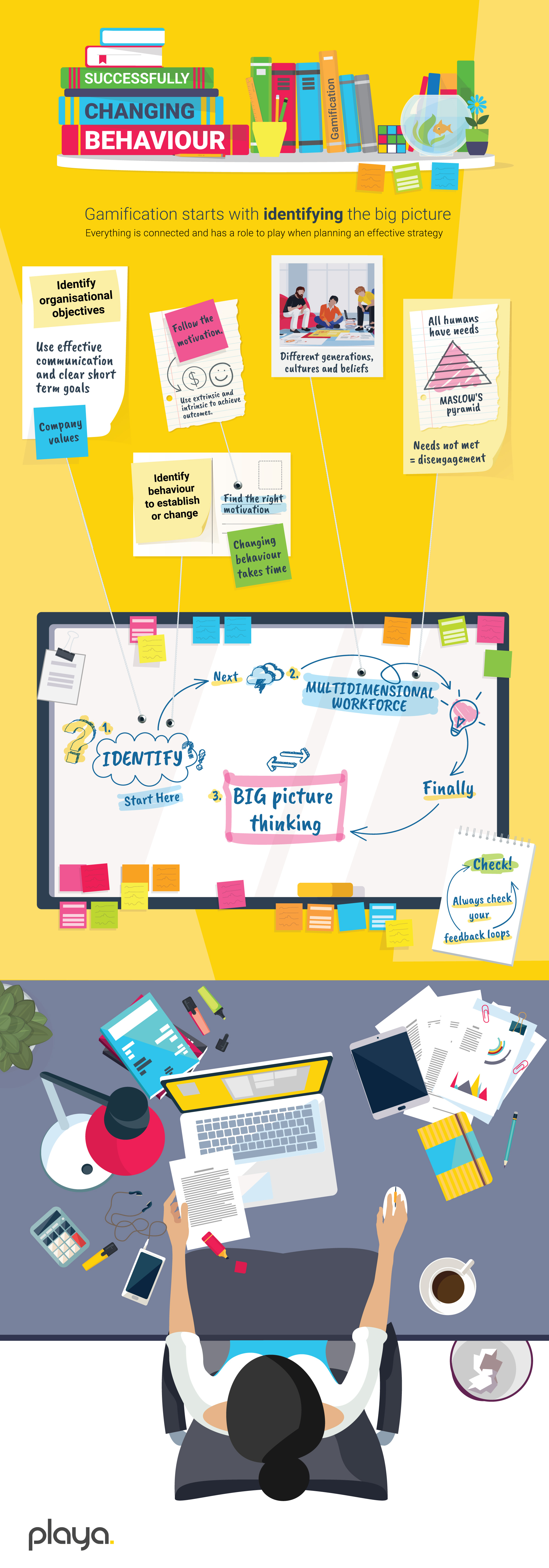
A planning overview for successful behaviour change

Everything’s connected. Use big-picture thinking to get an overview of the many moving parts that make up an effective gamification strategy.

When your objective is behaviour change, it’s easy to get lost in the details and lose sight of the ‘big picture’. Identifying all the ‘moving parts’ is certainly important but take a step back from time to time and see how all the various components come together to create synergy.

Here’s an overview showing some (but not all) of the elements you need to consider. In short, you want to identify your organisational objectives and ensure they align with your company values. Look at the behaviour you want to establish or change and then give some thought to the motivators that will help you achieve this.

Be mindful that your workforce is multidimensional and that needs and desires will vary considerably. Also remember that changing or establishing behaviour takes time and cannot be rushed, too much too soon and you’ll stress out your target audience. Carefully monitor your feedback mechanisms at every turn and don’t forget that all important dose of perspective
– that’s big picture thinking!

Infographic_Behaviour_Change

Bringing gamification to life

Bring your gamification to life. Know the importance of goal setting, which rewards work best, ideal task complexity and the social behaviour of users.

Goal setting

Manageable sub-tasks and stimulating side-quests make all the difference. By breaking the task down into more manageable missions, participants can choose which task to tackle first.

Task complexity

If the game element is sufficiently challenging, the participant will get a sense of satisfaction from completing the task. If participants excel at a particular element, they will feel encouraged to ‘level up’ and take on more challenging aspects of the gamified solution.

Rewards

For quick behaviour change, use a continuous reward schedule. Warning: if the rewards are withdrawn, the desired behaviour may decrease or cease altogether.

Social behaviour

Participants need a sense of purpose and a sense of self within a social context. Tapping into these very powerful intrinsic core drives is a slam-dunk for gamification solutions.


Bringing-gamification-to-life